The insurance and financial businesses of the PZU Group are the foundation of Poland’s social and economic security. The business activities undertaken affect the surroundings, the environment and the quality of life. That is why the PZU Group pays very close attention to developing in a sustainable manner, taking into account the current needs of stakeholders and caring for the future of the next generations.
The PZU Group is gradually introducing the concept of sustainable development into more areas of its business. This allows them to gradually improve their business efficiency, the quality of the relationships they build, or better match the needs of their stakeholders. In the long term, this translates into an increase in the potential to build value and greater resilience of the entire organization to the impact of negative external factors.
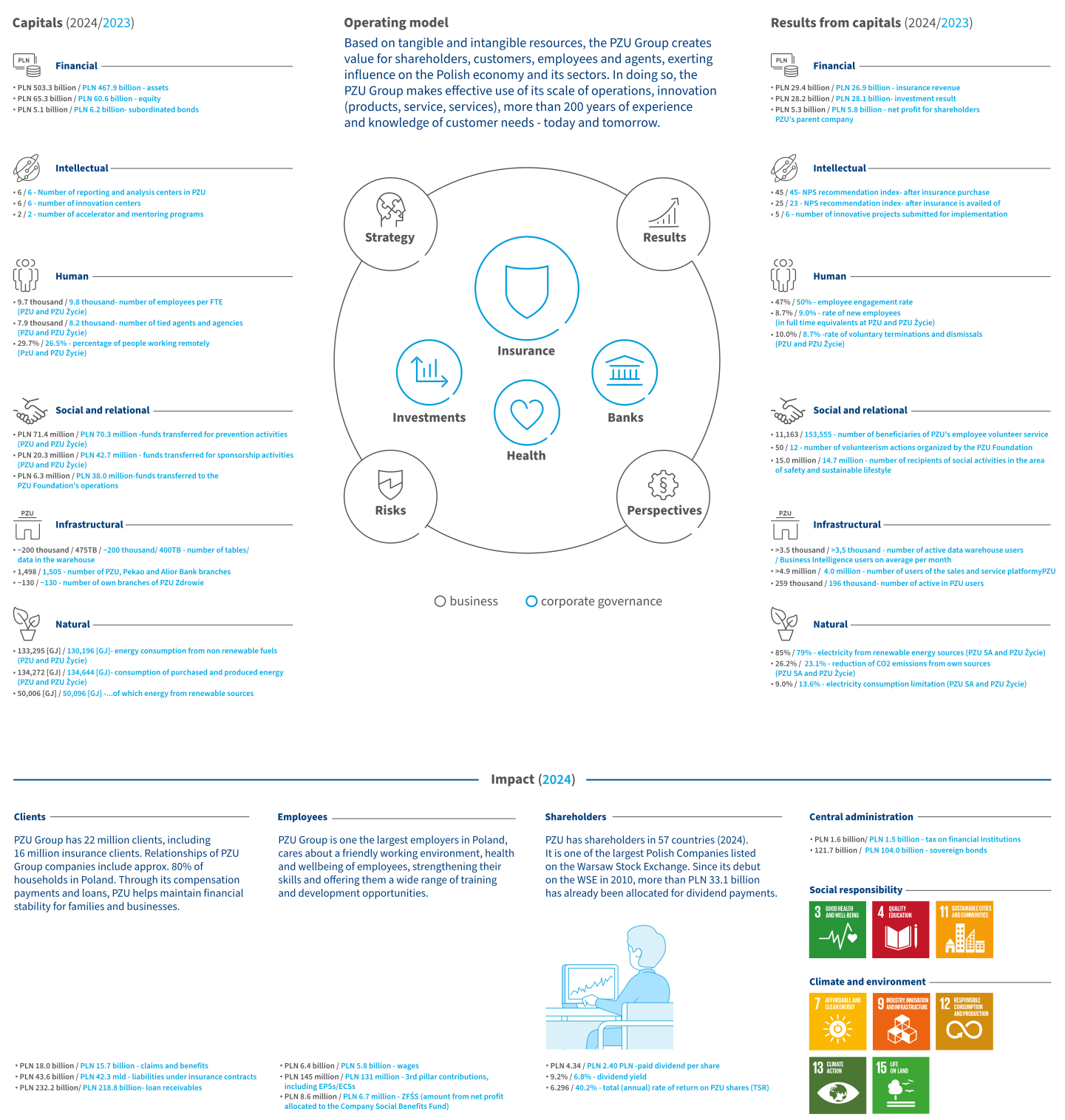
The management aspects are described based on the International Integrated Reporting Council’s “IIRC” guidelines.1 At this point, we present crucial issues of value creation over time with the use of available capital, i.e. the resources that the organization can access and use to create value.

Financial capital
This category includes financial resources held by the PZU Group, obtained from external sources (clients, shareholders, bondholders) and internal sources (profits generated on the Group’s business operations).
| Financial capital (PLN) | 2023 | 2024 |
|---|---|---|
| Assets | 467.9 billion | 503.3 billion |
| Equity | 60.6 billion | 65.3 billion |
| Subordinated bonds | 6.2 billion | 5.1 billion |
Performance management pertaining to this type of capital includes in particular activities related to:
- maintaining financial security and stability;
- ensuring funds for the development and pursuit of the strategy;
- operational and cost effectiveness.
Example of impact on other capitals:
- intellectual (innovation dynamics);
- human (salaries-costs);
- social and relationship (the scale of support for local projects);
- infrastructural (number of branches);
- natural (green investments, taxonomy, emissions offsets).
| Financial capital – results (PLN) | 2023 | 2024 |
|---|---|---|
| Insurance revenue | 26.9 mld | 29.4 mld |
| Investment income | 28.1 mld | 28.2 mld |
| Net profit for shareholders of PZU parent company | 5.8 mld | 5.3 mld |
Capital management
On 25 March 2021, the PZU Supervisory Board adopted a resolution to approve the PZU Group’s Capital and Dividend Policy for 2021–2024. The adopted policy was a continuation of the principles set forth in the PZU Group’s Capital and Dividend Policy for 2016–2020. In keeping with the Policy, PZU Group endeavors to:
- manage capital effectively by optimizing the usage of capital from the Group’s perspective;
- maximize the rate of return on equity for the parent company’s shareholders, in particular by maintaining the level of security and retaining capital resources for strategic growth objectives through organic growth and acquisitions;
- ensure sufficient financial means to cover the Group’s liabilities to its clients.

The policy allows for certain temporary deviations in the actual solvency ratio above or below the target level to occasionally occur.
Update of Capital and Dividend Policy for 2025– 2027
On 2 December 2024, the PZU Management Board adopted the Capital and Dividend Policy for 2025– 2027.
More information: Capital and Dividend Policy
Source and data: data after Q3 2024; PZU data (unaudited)
| SCR | 2023 | Q3 2024* |
|---|---|---|
| PZU Group | 229% | 227% |
| PZU | 238% | 238% |
| PZU Życie | 360% | 360% |
| MCR | ||
| PZU Group | 359% | 367% |
| PZU | 901% | 906% |
| PZU Życie | 800% | 801% |
| CCR | 2023 | 2024 |
|---|---|---|
| PZU Group – total solvency ratio | 16.8% | 16.1% |
| Tier 1 | 15.2% | 14.9% |
| Alior Bank Group – total solvency ratio | 17.8% | 18.3% |
| Tier 1 | 17.2% | 18.3% |
Commentary on ratios in banks:
In Bank Pekao and Alior Bank, the capital adequacy ratio and the Tier 1 ratio were computed on the basis of Regulation (EU) No 575/2013 of the European Parliament and of the Council of 26 June 2013 on prudential requirements for credit institutions and investment firms (CRR) and also the various types of risk identified in the Internal Capital Adequacy Assessment Process (ICAAP).
Intellectual capital
As regards intellectual capital, of key significance to the PZU Group are the intangible resources of the whole organization and distinct employees in the form of knowledge, experience, research, development and pursuit of a culture of innovation.
| Intellectual capital | 2023 | 2024 |
|---|---|---|
| Number of reporting and analysis centers in PZU | 6 | 6 |
| Number of innovation centers in the Group | 6 | 6 |
| Acceleration and mentoring programs | 2 | 2 |
Performance management pertaining to this type of
capital includes in particular activities related to:
- developing CRM systems, tools for remote sales and
contacts with clients; - personalizing the product offering;
- building product ecosystems;
- integrated approach to distribution channels
(omnichannel approach); - implementation of Group standards and regulations;
- building an environment favorable to innovation.
Example of impact on other capitals:
- financial (operating expenses);
- human (competence; well-being);
- social and relationship (client satisfaction, location);
- infrastructure (availability of offerings);
- natural (product innovation).
| Intellectual capital – results | 2023 | 2024 |
|---|---|---|
| NPS recommendation index – after insurance purchase | 45 | 45 |
| NPS recommendation index | 23 | 23 |
| Number of innovative projects submitted for implementation | 6 | 5 |
Approach to innovation
Innovation is one of the key values for the PZU Group. Innovation thinking outside the box, breaking molds and looking for opportunities to streamline functioning of the company. Innovation in the PZU Group is not limited to a single division, project or area. Changes are constantly being made to every aspect of how the firm operates, and they combine to form a picture of one of the most innovative companies in the financial industry in Europe. PZU’s innovations contribute to client satisfaction, which is a top priority for the Group, and to employee comfort, and at a micro scale, to the development of the overall economy.
Innovation in the PZU Group’s product and service offering
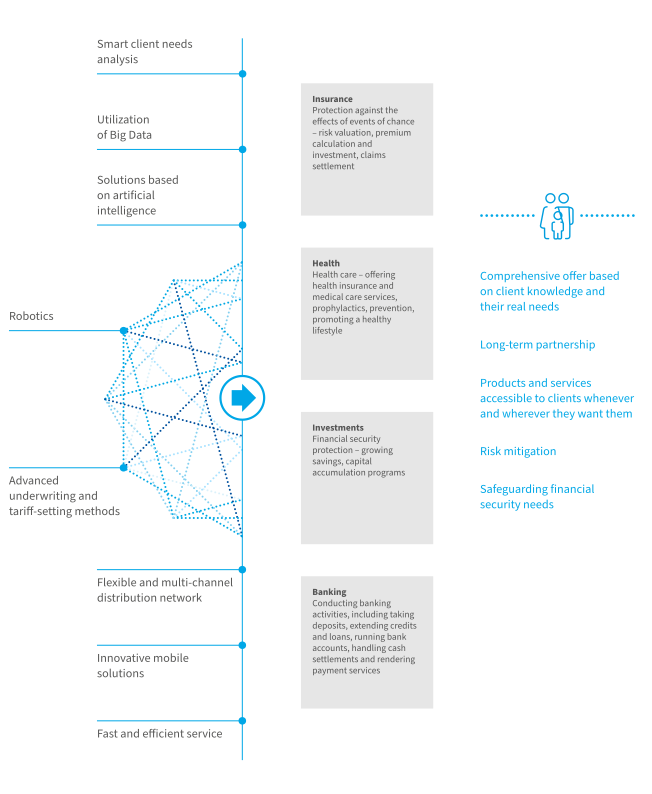
The innovation approach adopted by PZU supports the pursuit of the overall PZU Group’s mission and strategy. Four major areas are set forth thereunder, in which particular effort is expended to find new solutions, with a special focus on high-volume processes:
- digitalization (particularly AI and advanced analytics);
- client interaction and loyalty;
- ecosystems: health, automobile (drivers), repair network;
- Value Added Services.
One of the key ongoing activities is the development of the analytical and operational area of CRM towards full integration with digital channels in order to better personalize offers throughout the client relationship lifecycle (Customer Journey). And also in terms of closing sales paths by means of, among other things, using knowledge of client interactions to implement after-sales and maintenance campaigns adequate to clients’ needs (in 2024 production launch of CRM Interaction solutions integrated with, among other things, #mojePZU and pzu.pl digital channels). In the past year, about 6.6 million individual sales campaigns were carried out based on information gathered from the Data Warehouse. By extending actuarial models with new parameters and additional external data, underwriting processes were developed, providing more precise risk estimates and better price proposals for clients.

Work is currently underway to increase the precision of tariff models, which will translate into increased efficiency in risk selection. In the area of claims and benefits, advanced analytical models are used, among other things, to support clients in selecting optimal paths of claims manageability and matching settlement forms. In 2024, implementations of advanced machine learning analytics in this area were completed for non-commercial insurance, covering claims processes across all product lines. Tools for finding nonobvious relationships in data (data mining), text, image and voice recognition to automate damage estimates, graph networks to detect insurance crime and organized groups (FMS – Fraud Management System), or RPA robotics have also been developed for many years.
Responsible approach to data use and analytics
Artificial Intelligence (AI) brings both the potential for benefits and challenges related to data privacy, transparency, ethics of data use and security. The PZU Group is consciously and responsibly developing it and implementing the above solutions, as well as expanding Data Governance Policies to include Analytics Governance taking into account the AI Act, Data Act, Data Governance Act and DORA, among others. In order to properly address the above elements, an interdisciplinary AI Gov team is in place at PZU, consisting of representatives from numerous areas, both those producing AI systems and models (manufacturers), business units using AI systems and models (consumers), and units responsible for legal, risk, compliance, data management and security issues.
Data as a key value of PZU
Due to the dynamic development of the digital world and the arrival of data as an information resource, the PZU Group is constantly developing its reporting and analytical solutions, pursuing its mission to increase competitive advantage through the effective use of data. Reliable data is a vital asset for the company and is essential for business processes such as, among others, risk assessment, underwriting, accurate tariff estimates, combating fraud and insurance crime, personalizing offers and broader portfolio management, as well as claims and benefits handling. For more than two decades, the Information Management Department has been developing a corporate Data Warehouse and reporting and analytical solutions (Business Intelligence) that are a key element of the organizational culture and strategic approach to business management in the PZU Group. The Data Warehouse gathers information from more than a hundred internal and external sources (currently more than 90,000 attributes, current and historical data from the last 25 years) in such a way that it can serve in strategic, management and operational decision-making processes. In order for the mission of information management to be fully realized, modern ICT infrastructure solutions are being implemented that are adapted to the volume and type of data and users, technologies and analytical techniques that are adequate to business demand and meet market standards, and tools that provide information recipients with fast and uninterrupted access to data and analyses. It is one of the largest information ecosystems in this part of Europe.

An example of optimizing and improving the efficiency of reporting processes is the significant reduction in the time required for financial month-end closing and IFRS17 reporting, which allows for faster delivery of key information to shareholders and regulators. Given the growing importance of sustainability and environmental responsibility, new ESG and CSRD reporting processes have also been implemented, allowing us to transparently present our activities in these areas.
In terms of expanding advanced analytics environments and processes, the ML-Ops Hub has been established to manage, inventory and, most importantly, create and continuously improve machine learning (ML) and artificial intelligence (AI) models. As a result, new analytical models have been successfully implemented to support business processes and accelerate datadriven transformation.
Value resulting from data-driven transformations
The total estimated value of achieved ROI for completed projects and initiatives that make significant use of data and analytics now exceeds 10% of the annual technical result.
Key areas of analytical support
New business, client acquisition, network efficiency (market and competitive analysis, client needs analysis, channel optimization and sales efficiency)
Marketing, telesales, CLTV client value enhancement and loyalty, segmentation, campaign management (including x-sell and up-sell product recommendations, exit prediction and retention management), Customer Experience, hyperpersonalization of content and hybrid model of offering and after-sales service in digital and traditional channels.
Product creation and underwriting (product creation, modeling in the area of tariffs, underwriting and optimization of price elasticity, customization of offers).
Claims handling process management (segmentation, claims handling analytics, vehicle repair costs analytics, path manageability and partner ecosystem analytics), increased fraud efficiency and detection (fraud pattern analytics and fraud prevention models, SNA networks).
Risk management and recovery optimization (portfolio insurance risk analytics, predictive analytics, reserve management, recourse optimization and accounts receivable management), reporting and management accounting (including activity-based costing, budget and performance planning and monitoring).
Dynamic development of advanced analytics, including machine learning and artificial intelligence (AI)
The PZU Group has also been investing for years in digitization and automation of processes, but it also makes significant use of data, behavioral and phenomenal patterns, new analytical techniques and technologies, including artificial intelligence (AI) and machine learning (ML). New technologies are the way to better understand the needs and provide more comfort to clients, to serve them more efficiently, but also to better assess risks and consequently value insurance, optimize claims handling processes or, finally, to improve systems for detecting insurance fraud and crime. It is also a way to gain competitive advantages in a world where personalized offers and sales in digital channels are playing an increasingly important role. There are currently more than 300 analytical models in the PZU Group. Today, AI in the PZU Group is used not only to automate and optimize internal processes, but also to improve experiences and relationships with current and potential clients. However, the solutions implemented do not completely take control of the processes, but are only suggestions and hints. The decision always lies with the person – the client, employees or intermediaries.

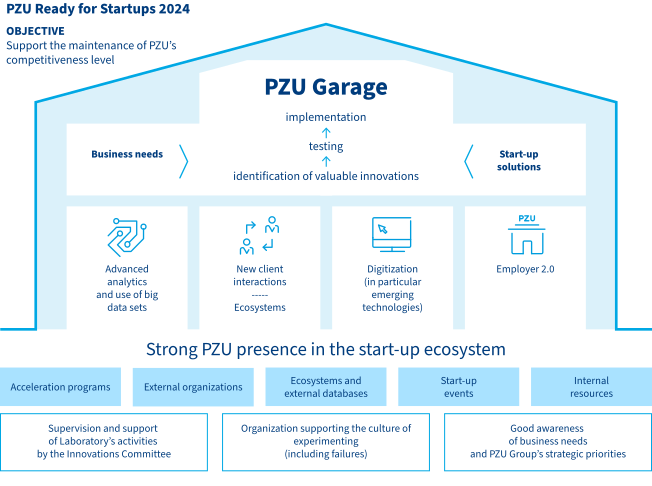
PZU Ready for Startups
PZU Ready for Startups is a program to work with startups and technology partners to test and implement innovations at PZU. They cover business areas, and involve solutions at various stages of development – from initial ideas directed to accelerator programs, to commercial implementations preceded by a short process of adapting solutions to business needs.
Since the program's launch, PZU has already conducted 77 pilots, which have resulted in nearly 50 projects submitted for implementation. The cumulative business benefits generated by the implemented solutions have already exceeded PLN 200 million.
Innovation and AI team
The PZU Group is fully aware that innovations call for making creative space conducive to generation of ideas, as well as prototyping, testing and implementing unique original solutions. This is the role of PZU’s Innovation and AI Team. Its overarching task is to search for modern solutions, check them, perform tests and support rollouts. Moreover, special processes have been forged in the entire organization to facilitate rapid testing and implementation of innovative solutions.
In 2024, over 1000 ideas and start-ups were analyzed; and 14 pilots of innovative solutions were launched. There were 9 pilots which were completed, and 5 out of those 12 were advanced to the implementation phase. Among them were solutions to support actuarial processes, claims and benefits handling processes, the multiagency sales area, as well as AI solutions that have a positive impact on the efficiency and quality of work of all PZU employees. Since the inception of the Innovation area PZU has completed many unique projects, which have been awarded more than 35 industry prizes. In 2024, PZU received the prestigious Celent Model Insurer 2024 award and the Innovation Diamond in the “Patron of Startups” category.
GPT Lab
The process is constantly monitored, and the right approach to artificial intelligence testing ensures that experimenting with this technology is safe and reliable. The GPD Lab functions as a working team within the PZU, consisting of representatives from the Innovation and AI Team (ZLI), the Information Management Department (BZI), the Artificial Intelligence Factory (FSI) and the Development and Deployment Department (BRW). The above units are core areas where experts use the latest advances in AI and machine learning to analyze the vast amounts of data available at PZU. In 2024, GPT Lab implemented, among other things, a generative artificial intelligence solution to support PZU Dom’s self-service claims handling process (the Self-Service Next project), and piloted AI Assistant, a secure tool based on GPT models, designed to support PZU employees in their daily work. As part of the pilot, about 1,000 employees had the opportunity to test the solution and learn how to use GenAI tools in practice. Based on the experience of the pilot, implementation of such tools for all employees of the Company will be implemented.
Accelerator programs combine the potential of young, creative entrepreneurs with the infrastructure and experience of large companies. Their goal is to accelerate the growth of startups by, among other things, allowing them to test their solutions with large companies, providing financial support and scaling up their operations. PZU wants to support innovators who are at the beginning of their journey or are just gaining momentum.
PZU participates in two accelerator programs, Huge Thing and Start Smart CEE, which combine the potential of young, creative entrepreneurs with the infrastructure and experience of large companies. Their goal is to accelerate the growth of startups by, among other things, allowing them to test their solutions with large companies, providing financial support and scaling up their operations. PZU wants to support innovators who are at the beginning of their journey or are just gaining momentum.
PZU has partnered with three start-ups in 2024 as part of its accelerator programs. The first startup selected by PZU is RIFFSEC (Huge Thing accelerator), which provides cyber security departments with information on data leaks, darknet monitoring, Telegram and information on planned phishing attacks. The team has experience in the area of cyber threat intelligence, which is the continuous monitoring, detection, analysis and response to cyber threats. The second entity is simpl.rent (Huge Thing accelerator), which operates at the intersection of fintech, insurtech and proptech. The Company offers innovative solutions for improving standards in the residential rental market. One of the latest solutions is the proprietary Sherpa – a universal online insurance distribution platform. In turn, Muffintech (StartSmart CEE accelerator) is a startup focused on conversational artificial intelligence solutions, i.e. one you can talk to, distinguished by its focus on the insurance industry. Its large language model (LLM) is specially trained for insurance, making it better able to handle documentation overflowing with professional vocabulary.
Human capital
Human capital management involves matters related to creating a workplace, caring for safety, building relationships and dialog, supporting diversity, managing talents, and retaining key employees.
| Human capital | 2023 | 2024 |
|---|---|---|
| Number of employees per FTE PZU and PZU Życie) | 9.8 ths | 9.7 ths |
| Number of tied agents and agencies PZU and PZU Życie) | 8.2 ths | 7.9 ths |
| Percentage of people working remotely PZU and PZU Życie) | 26.5% | 29.7% |
Performance management pertaining to this type of capital includes in particular activities related to:
- diversity and respect for human rights;
- ensuring safe working conditions;
- development and training;
- hiring and retaining key employees;
- ensuring a healthy work-life balance;
- ensuring conditions for an honest dialog with trade unions;
- shaping ethical attitudes
Example of impact on other capitals:
- financial (operating expenses);
- intellectual (culture of innovation);
- social and relationship (brand recognition);
- infrastructure (availability of offerings);
- natural (awareness of the impact on the environment).
| Human capital – results | 2023 | 2024 |
|---|---|---|
| Rate of employee involvement | 50% | 47% |
| Rate of new employees (in fulltime equivalents at PZU and PZU Życie) | 9.0% | 8.7% |
| Rate of voluntary terminations and dismissals (PZU and PZU Życie) | 8.7% | 10.0% |
Social and relational capital
This type of capital is made up of shared norms, values and behaviors that build long-term and lasting relationships with stakeholders. These are aspects related to client loyalty, brand perception and preventive, sponsoring and social activities.
| Social and relational capital (PLN) | 2023 | 2024 |
|---|---|---|
| Expenses for prevention activities PZU and PZU Życie | 70.3 million | 71.4 million |
| Expenses for sponsorship activities PZU and PZU Życie) | 42.7 million | 20.3 million |
| Funds donated to the PZU Foundation | 38.0 million | 6.3 million |
Performance management pertaining to this type of capital includes in particular activities related to:
- setting standards for cooperation with suppliers and business partners;
- deploying systems to improve client service;
- approach to recruiting and supporting agents;
- promoting a healthy lifestyle;
- disease prevention;
- accident prevention;
- providing support to local communities;
- supporting activities aimed at promoting sports, culture and art.
Measurement of the effectiveness of this type of capital is largely based on analyzing the outcomes of preventive and sponsoring campaigns, social campaigns and socially beneficial projects, and the use of funds allocated to activities pursued by foundations. Example of impact on other capitals:
- financial (price elasticity);
- intellectual (brand recognition);
- human (engagement);
- natural (environmental awareness in the supply chain).
| Social and relationship capital – results | 2023 | 2024 |
|---|---|---|
| Number of beneficiaries of PZU employee voluntarism | 153,555 | 11,163 |
| Number of volunteerism actions organized by the PZU Foundation | 12 | 50 |
| Number of recipients of community activities on safety and sustainable lifestyles | 14.7 million | 15.0 million |
Infrastructural capital
This type of capital is made up of the largest distribution and service network in Poland, in particular: branches, outlets, agents and business partners, the claims and benefits handling network, and electronic distribution channels. It also includes one of the largest corporate PZU Data Warehouses in Central and Eastern Europe as well as reporting systems and ML/AI advanced analytics, IT tools and systems that enable information flow both within and without the PZU Group. As a result, PZU Group clients enjoy easy and convenient access to financial products and services.
| Infrastructural capital | 2023 | 2024 |
|---|---|---|
| Number of tables / data in the data warehouse | ~200 ths / 400TB | ~200 ths / 475TB |
| Number of PZU, Bank Pekao and Alior Bank branches | 1,505 | 1,498 |
| Number of PZU Zdrowie’s own branches | ~130 | ~130 |
Performance management pertaining to this type of capital includes in particular activities related to:
- growth of sales structures;
- organization of work in branches;
- growth and transformation of facilities in the health area;
- standardization of structures and positions;
- development of electronic distribution channels for financial products and services;
- digitization of processes within the PZU Group
Example of impact on other capitals:
- financial (operating expenses);
- intellectual (level of innovation);
- human (quality of client service);
- social and relationship (accessibility and countering exclusion);
- natural (emissivity).
| Infrastructural capital – results | 2023 | 2024 |
|---|---|---|
| Number of active data warehouse users / Business Intelligence users on average per month | >3.5 ths | >3.5 ths |
| Number of users of the sales and service platform mojePZU | 4.0 million | 4.9 million |
| Number of active inPZU users | 196 ths | 259 ths |
Natural capital
This is primarily the PZU Group’s direct and indirect impact on the environment.
| Natural capital – direct result | 2023 | 2024 |
|---|---|---|
| Electricity from renewable energy sources PZU SA and PZU Życie) | 79% | 85% |
| Reduction of CO₂ emissions from own sources PZU and PZU Życie) | 23.1% | 26.2% |
| Electricity consumption limitation – (PZU SA and PZU Życie) | 13.6% | 9.0% |
Performance management pertaining to this type of capital includes in particular activities related to:
- minimizing the environmental footprint, reducing own and indirect CO2 emissions;
- shaping the investment policy;
- building climate awareness among employees, clients and partners;
- involvement in the climate and energy transition;
- implementation of ESG factors into operations;
- development of products for entities supporting lowemission technologies.
Example of impact on other capitals:
- financial (commitment to green investments);
- intellectual (reduction initiatives);
- human (environmental awareness);
- social and relationship (pro-ecological products);
- infrastructural (transition to low-carbon technologies).
| Natural capital – indirect results | 2023 | 2024 |
|---|---|---|
| Increase of the exposure to investments supporting climate and energy transition – in total in 2021–2024 PZU and PZU Życie) | PLN 2.6 bln | PLN 2.9 bln |
| Assessment in terms of ESG factors of investments in ESGsensitive sectors (PZU and PZU Życie) | 86% | 90% |
| Integrating ESG requirements into key procurement processes PZU and PZU Życie) | 53% | 100% |
Value creation model [IIRC]